Saturday, July 28, 2018

Tales: If the Creek Don't Rise by Leah Weiss

Reviewing If The Creek Don't Rise
If the Creek Don't Rise is a fiction novel about Sadie Blue and the handful of residents of Baines Creek, North Carolina in 1970. Life in this remote and impoverished Appalachian town is terribly hard. Relationships are even harder. 

I found myself reading in every spare moment; while waiting in lines, first thing in the morning, and until I couldn't hold my eyes open any longer at night. This story had me hooked from the first shocking paragraph to the last paragraph that made me cheer aloud. Really.

About the ending, a reviewer describes it the best with: 
"The ending is the cherry on top of the best sundae you've ever wanted to have. After a carefully concocted blend of flavours, it ends with that bit of zing you weren't quite expecting"  - Cheri on Goodreads

But I'm getting ahead of myself. The story begins with Sadie Blue and how at age 17 she found herself married, pregnant, and the wife of the devil.


Sadie Blue


The story begins and ends intimately with Sadie Blue. With all the chapters in between glimpses of what others think about young Sadie, her abusive husband, and what it's like living life in Baines Creek. Each character distinctly different. 

We learn that Sadie's mother left the family while Sadie was very young. Her father, while he still speaks to her, has passed away. She was being raised by her grandmother when Roy Tupkin smiled and her heart fluttered. It wasn't long until she became pregnant, and with his hand on her belly the baby kicked.  
"Right then, with one baby kick, that man with the dark soul grinned, and it turned his face into something beautiful I never seen before. A light shined in his face on this cloudly day and wiped away shadows that lived behind his eyes"
That Thursday, they got married. They gathered her things and she moved in with him. 
"Now I stand on wobbly legs and whimper like a hurt puppy cause I can't help it. Today was beating number three since I got legal. I figure Roy don't need a reason no more. I close the trailer door against the chill, then shuffle to the bathroom to wash off the dried blood." 

Roy Tupkin


The villain is Roy Tupkin. He's a typical abusive, womanizing man.  Still a boy really. Good ol' Roy is easy to hate - then we get a peek into his life. While nothing excuses how he treats others, we get a glimpse into what causes him to be so maladapted. I didn't like him any better but I did understand where his problems began.

Roy isn't the only resident of Baines Creek who is maladapted. But most of them are likable - perhaps even lovable. Eli Perkins is the preacher who brings Ms. Shaw from the outside to teach the children. Prudence is his spinster sister who has secrets. Billy has a not-so-secret crush on Sadie. And so on.

Each character tells their story one by one in alternating first person narratives. Each voice is clear and memorable


The Author: Leah Weiss


If the Creek Don't Rise is a debut novel by Leah Weiss. This is a character-based story rather than plot-based. We get to know each of the many characters intimately and because of the glimpses into each of their lives, and each voice was easy to recognize. I was determined to know what comes next as soon as possible.
"The first stories I wrote were about my mom, Lucy, and her life on a tobacco farm in the 1930s. She was one of fifteen children living in an unpainted house without running water or electricity. She and I found a special bond talking about her childhood, which she thought no one care to remember. I didn't know that in a few months Lucy would die of cancer and I wold be left with grief and amazing fodder from those conversations." - Leah Weiss

To me, that explains how she got the voices of strong women who live in poverty in isolated, rural areas so correct.  I nearly didn't read this book, half expecting the usual condescension or trivialization that happens when outsiders try to describe lives such as these. But Ms. Weiss hit it spot on.

I will remember Sadie Blue, and who saved her, for a long time to come. 

*This article may contain affiliate links. If you shop via one of the affiliate links, I may earn a small commission - at no additional cost to you. I am very appreciative of every reader who visits my articles. Thank you.


Sunday, July 22, 2018

Travel: Conowingo Dam for Birding and Fishing Day Trips


Conowingo Dam and the Fisherman's Wharf area.
I have visited Conowingo Dam fishing area multiple times over the years. I enjoyed each day trip to the area whether I'm fishing or birding (or both at the same time). Today's visit wasn't spectacular in the birding category, but it was a good visit all the same. When I move away from Maryland, this will be one of the spots that I will miss immensely. At the risk of sharing my already not-so-secret spot, I decided to write about Conowingo Dam so that others can plan their own visits. 

Also, the Fisherman's Park of Conowingo now includes a wharf and stairs system that allows everyone (including children and families) to enjoy the area. Bring your cameras, fishing poles, family/kids/friends, and a picnic lunch and have a wonderful day.

Birding and fishing in one awesome spot

Conowingo Hydroelectric Plant


Conowingo Hydroelectric Plant opened in 1928. It is in the lower Susquehanna River, approximately 5 miles south of the Pennsylvania-Maryland state line. It is located near the Maryland small towns of Conowingo, Darlington, and Port Deposit. It is one of the largest non-federal hydroelectric dams in the US. 

It is an easy, but rural, drive just off US 1 or I-95.


The view from under the dam

Early morning view of the island where birds congregate

The fisherman's wharf is a beautiful system of stairs, rails, and concrete seating ledges. When I initially moved to Maryland, the fishing area at Conowingo was only a parking lot, and rip rap along the shoreline.  The fisherman's wharf was built in 2009. Many times, I am not a fan of building up natural areas, but in this case I am glad someone had the idea and carried this out to fruition. 


Wharf stairs and multiple overlooks


Multiple ledges for seating


View from a portion of the wharf


There is also a boat launch for small boats. However, it was closed today - I believe the sign said due to higher water. 


Bird Watching at Conowingo


This area has become a well-known Bald Eagle viewing area. A large population of Herons also are in the area. Today, we spotted many other bird species. I am not at all reliable at identifying bird species, but I am certain we saw Bald Eagles, Great Blue Herons, Cardinals, Crows, Osprey. and Black Vultures. We also saw what appeared to be cormorants, gulls, ducks, and swallows. We certainly heard a Pileated Woodpecker. 

There are many articles online written by more experienced bird watchers. For more accurate bird information, please consult those articles. My intent today is to increase awareness of the ease of access to the Eagles and other birds while I am still becoming better at viewing and identifying.

Bring your binoculars and camera and enjoy the day with the birds.


Bald Eagle spotted today


Great Blue Heron flying - and I need a zoom lens


Fishing at Conowingo


Before the wharf was built, I came to the area to fish for catfish. And I caught several. 

Information shows that people fish the area for bass, shad, catfish, walleye and more. Today, we watched folks walk out with large fish - a mixture of bass and catfish. The question, "any luck?" was not needed. Their catches were obvious. I was happy for them and found myself wishing I had brought my pole.

I saw mostly large rigs (poles and crankbaits) being used in the cast and reel quickly fashion. But I also saw some poles propped up and waiting for the tell-tale bobbing of the tip of the pole indicating "fish on".  That's more my style of fishing. And I saw plenty of that style too. Whether you use a lure or bait, crank or bottom-fish, there was someone having luck at it today.

A lovely morning to go fishing


Fish on!


Be Aware and Beware  


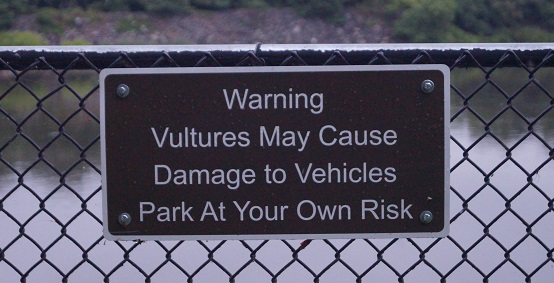
There are important signs regarding safety around the property. Read them and heed them.


* * * * * * * *


photo by W.L.S - with permission
Be aware that the red flashing lights and sirens indicate the dam is opening and releasing more water. It does not open suddenly, but it does create a higher water level. You should be aware, gather your things, and move to higher ground.

Signs indicate that the vultures may damage vehicles. This is NOT an understatement. The numerous Black Vultures in the area perch atop you car and in our case, removed the rubberized portion of the windshield wiper. 


Related Links:


Conowingo Fisherman's Park brochure - general information about directions, fishing, birding, and phone numbers for more information.

A very detailed article of interest to birders is provided by the Harford Bird Club. It was originally written in 2002 by Rick Blom but shows that there have been updates since. 

*This article may contain affiliate links. If you shop via one of the affiliate links, I may earn a small commission - at no additional cost to you. I am very appreciative of every reader who visits my articles. Thank you.


Sunday, July 15, 2018

3 Reasons I Want to Build a Small Home

The Shack 
There are many reasons to build or live in a very small home. There are as many different reasons for living tiny as there are people who are doing it. The three main reasons I want to build small are: lower cost, less clutter, and lower negative impact on the environment.

Over the decades, I've always tended to live in smaller spaces and I guess as a result, I am more accustomed to smaller spaces. As an adult, I've only lived in two "large" homes (meaning, over 1,400 sq ft).  Over my lifetime, the American Dream seemed to be that big house with the picket fence. So I felt a little strange about admiring and dreaming about the small homes.  

Fortunately, somewhere along the way I decided to live my dreams - whether it was popular or not. And somewhere along the way, small homes became the America Dream for more people.

This is being written during the process of planning for retiring off-grid. Or being on-grid but as self-sustainable as I am able to be. I have purchased my land with a currently off-grid, dry, hunting cabin that I lovingly call The Shack. 

This is more about the three reasons I am planning on building small.


1. Low Cost - Moving Toward Debt-Free Living


Please be clear that I'm not knocking people who live in large homes with large price tags. There are many reasons to live in a large home and a lot of people dream of living in a large home. And I think everyone should live their own dream. Some people choose to buy a large home in a desirable area as a retirement investment. I think that's a fantastic idea for some people. But that's not for me. 

My plan had been to pay off the land, then pay cash as I go to make the improvements; the septic, water, then the house.  My plan was to do this over years and be debt-free when I retire. My idea of the American Dream is to retire with no debt and very low monthly bills. A very small (or no) mortgage would help this happen.

As time goes on, and my desire to be there sooner as opposed to later, my plans change. I may not get up there debt-free, but I still want my debt to be as low as possible.

I am not able or willing to remodel or build my own home. So I'll hire someone. That will increase the cost. But even so, building a modest home at less than 800 square feet carries a much lower price tag than building a large home.

The current house plan I have in mind is approximately 640 sq. feet. If it costs $100 per square foot, my 640 sq. ft. home would cost $64,000 while a 1400 sq. ft. home would cost 140,000. I really like the difference in those price tags!

2. Preventing the Clutter and Excessive Consumerism


Oh my gosh, I am my mother's daughter. She was a hoarder. And probably could have been a guest on the hoarder tv series.  I'm not quite that bad. But I easily could be. And living in large spaces only invites buying A LOT of things. 

I like to have things. But I think overall, Americans overdo it in regards to having "stuff". I personally want to live in a small space in order to help keep that excess consumerism from setting it. I don't want to buy a bunch of things I'll use once or twice then have to make room to store for the rest of my life.

I'm certainly not a minimalist. But having less things makes me happier than having a literal ton of things.


Reduced Time Spent Cleaning?

Related to the topic of clutter, some tiny-home advocates report that the time spent cleaning a tiny home is significantly reduced.  I'm not completely sure that I buy into that argument 100%.  Yes, it takes less time to mop a kitchen floor that measures 6 x 10 than it took to mop my old house kitchen that probably measured 10 x 14 (or larger. It was a HUGE country kitchen). But, I think that keeping everything in it's place in a small home, with multiple use spaces, is also time-consuming.

For example, when camping at The Shack, I get all of my bedding out of the mouse-proof containers and make my bed. Then I put the bedding away, into the storage containers. Because where my bed is made is also my "living room" floor. Every time you have a "multiple use" space and have to spend time storing things away, it takes some time. 

So I think the reduced time for cleaning may or may not be true depending on the area. If there isn't an overabundance of things that need to be stored, getting them out and putting them away each day won't be as time consuming. 


3. Low Environmental Impact 


When people refer to reducing the environmental impact, they are usually referring to having a small carbon footprint. 
"A carbon footprint is historically defined as the total emissions caused by an individual, event, organisation, or product, expressed as carbon dioxide equivalent" - wikipedia
My desire to live in a really small home has to do, in large part, with a desire to keep heating/cooling/energy costs and usage as small as possible. Reducing that carbon footprint. I previously owned an older, 1,400+ square foot home and cringed at how much energy it cost to keep that place remotely close to comfortable.

I also think of low environmental impact in the aspect of visual pollution. Personally, I don't like seeing the farm land that was turned into a subdivision of 100 homes. I don't like seeing forests cut down to make way for manicured yards.  Again, I'm not insulting people whose dreams include living in those situations. Live your dreams and love it. Don't try to please anyone other than yourself. However, it's not for me. Those sights are usually visual pollution to me. As are homes that are built on the top of a mountain or ridge and can be seen plainly from the valley below.

My plan to build a small home in place of The Shack has a lot to do with not interrupting the view from below. If I plan this right, my small home will be invisible from the valley below and that thought makes me happy.  I want the neighbors to gaze upon my trees - not upon my house.

Related Small Home Links:


Small home plans

The Big Book of Small Homes Plans is FULL of awesome home plans under 1,200 sq. ft. This book has given me many great ideas for the inside layout options and exterior options.

Lancaster Cabins

Are you interested in a tiny house on wheels or a park model? I toured Keystone Kabins (now named Lancaster Cabins) and LOVED, loved, loved those cabins. If my land was unrestricted, one of these cabins would already be parked there. They are a must-see for tiny home lovers. 

The Shack - A Quick Peek

And here is a quick peek (and a first video attempt) of the inside of The Shack during the before stage. 

*This article may contain affiliate links. If you shop via one of the affiliate links, I may earn a small commission - at no additional cost to you. I am very appreciative of every reader who visits my articles. Thank you.


Sunday, June 24, 2018

Making Homesteading Dreams Come True - Claim It

I claimed it with this rock in my pocket.
I am not yet living on my "homestead". But each day I am getting closer to making that dream come true. Frequently, I witness others saying they have a homestead dream but they think they can never make that dream come true. I want to say to them that if I can do it, anybody who wants it can do it too. I am no expert on buying land. And I am not yet living on my land. I may never live on my land. But I am one step closer to making my dream come true. And meanwhile, camping on my land brings me much joy. 

I want to share the steps I'm taking so that maybe someone can feel more hopeful about making their dreams come true. If I've found a way to get this far, you can too.


It's Your Dream - Claim it. 


My first piece of advice is to claim your dream. Physically do something that symbolizes claiming your dream. I didn't realize it then but that was exactly what I was doing the day I put a rock in my pocket.

Looking back, I claimed my homesteading dreams in many ways. But the most significant (and physical) "claiming" was that silly little rock.

The rock in my pocket happened in 2015. The portion of time that has to do with physically claiming my land happened from approximately August to October.  I wrote a post about that year, the extreme ups and downs of the second half of that year. It's still all pretty surreal and you can read about that hereWith the circumstances during that time period, it seemed that there was no time like the present to invest in some land for a retirement plan.

In August, I began working with a realtor in West Virginia to find land. I drove to look at many small parcels. Off-grid was fine. A low price tag, a roomy feel (i.e. no immediate neighbors), and the ability to own chickens was my "must" list. Everything else was negotiable.

I fell in love with 5 acres. But it went under contract almost by the time I drove back to Baltimore and thought it over for a day or two.

I looked at more land. Then I mentioned to the realtor that I thought I'd really like that little "red" house on the hill... but the HOA doesn't allow chickens. Or so I thought. My realtor let me know that the "restrictions" on that land did not exclude chickens and small livestock. We agreed to go look at that little hunting cabin on the hill, and some other pieces of land.

As soon as I parked on the edge of the road in front of that little hunting cabin, I knew this was the place. Thank goodness I hadn't be able to buy that five acres! I couldn't believe I had actually cried over losing the other place. I finished the day and went to look at the other parcels of land we had lined up to see. Just to be sure. 

Then I asked my realtor if I could just go sit on the top of the hill at the little "red" house (it looked red in photos but it is really a dingy brown).

I went alone and sat there. I felt it was already mine. It felt familiar and like it was where I belonged. I picked up a rock and put it in my pocket. And intended to carry "my" rock in my pocket until the land was mine.

taken during a subsequent visit - the rock was already in my pocket

As I drove back down the switchback road to get to the highway, a bear slowly galloped across the road in front of me. I took that as a good sign (although, I'm not completely sure why it felt like a really good omen)

The realtor said she told the owners about my bear sighting. And they reported to her that they'd never seen a bear. I was afraid they thought I was lying. But it didn't much matter and I felt like that bear intentionally crossed in front of me.

I made the offer and waited. Then I worked at finalizing with the bank and getting through the closing process. It took nearly 2 months of waiting. And I carried that rock in my pocket every day.

I had to work to not be anxious while waiting. Because of my "blemished" credit and a history of being turned down by some banks through my lifetime there was a chance I'd have problems. I half expected to be sabotaged in some way but I carried my rock in my pocket. 

On October 29, 2015, I signed for my land. And I put the rock back where it belonged. Well sort of. The rock is on the window sill at The Shack.

I am convinced that doing something physical to claim my dream helped my dream begin to come true. I am convinced that if you physically claim your dream in some small symbolic way (not outlandish ways.. I'm not advising you to lock yourself in the bank vault in order to have your dream of riches come true!) you will move closer to making your dreams come true.

*  *  *  *  *  *  *  *  *  

P.S. Is it coincidence that I'm a farm girl from Indiana and I found these rocks during subsequent visits to The Shack?  I think it's no coincidence at all. 

I think they are more signs that I am on the right track.


P.S.S. My game cam has since caught photos of a bear on my land. You can see those photos and more from my game cam here


*This article may contain affiliate links. If you shop via one of the affiliate links, I may earn a small commission - at no additional cost to you. I am very appreciative of every reader who visits my articles. Thank you.


Friday, June 22, 2018

Travel: Seneca Rocks, West Virginia

The view from the Seneca Rocks Discovery Center. 
This past week I hiked the Seneca Rocks trail. I didn't give up and I made it to the top! It was a glorious feeling of accomplishment and a wonderful adventure in a beautiful setting. It was beautiful and you can be sure I'll go back. 

Due to the time of day (nearly noon), getting wet, and the haze from the heat of the day, my photos don't do justice to the beauty of the area. 


What the Seneca Rocks Trail IS:


  • Seneca Rocks is an unincorporated community in Pendleton County, West Virginia (at the intersection of route 33 and route 55)
  • Seneca Rocks is a rock formation located within the Monongahela National Forest. 
  • The hiking trail can be accessed from the Seneca Rocks Discovery Center or the Homestead Site and Picnic area.
  • The hiking trail is 1.3 miles and climbs over 700 feet
  • The trail is a wide, maintained, path of uphill and switchbacks.
  • There are occasional benches and two sets of stairs in one particularly steep location
  • The observation deck is near the top of the rock formation and is cantilevered over the land below. The views of the area below are beautiful.


What the Seneca Rocks Trail and Observation Deck Is Not:


  • The observation deck is not at the top of the rocks, as I had hoped.
  • The view is not of the rocks, as I had hoped. I had hoped for a glimpse of rock climbers. The "view" is the same view you would have from the rocks of the valley and ridges below. 
  • If you are a serious hiker and prefer difficult trails, this is not what you are looking for. The difficulty on this trail is the climb. Otherwise, it is like a stroll on a wide, civilized gravel path. 


My Experience at Seneca Rocks


I felt a little rushed as I had left the dogs alone at The Shack and I was concerned they'd get too hot with only the windows open (instead of the doors hanging wide open like they do when I'm there).  I hadn't really planned on taking this hike during this trip to The Shack. But there's no time like the present, right? So off I went. I'm glad I did. But next time I'll be better prepared with my backpack, binoculars, and a picnic lunch.

My GPS didn't pull up "Seneca Rocks" but it did pull up the nearby town of Macksville. The winding two lane highway offered beautiful views for the 1 1/2 hours I drove from The Shack.

When I arrived, I found there were two parking areas, and initially I was confused. There was the Discovery Center parking area and the Picnic area at the Sites Homestead. However, both areas are connected by a bridge and a path. 

The Discovery Center provided a bench and a wonderful view of the rocks. Were it not for feeling rushed, I would have sat for awhile. The Discovery Center offered a continuously running movie, excellent bathrooms, a gift shop, and some information about the rocks and about invasive plant species in the area. 

The Sites Homestead and picnic area provided a parking lot, covered picnic area, a rustic park bathroom, and the old homestead house and garden area. 


The Sites Homestead and gardens

The hiking path started up and over a bridge. Initially, the path was flatish, and I thought to myself, "at this amount of rise, it's going to take all day to get to the top". Well... I spoke to myself too soon. The climb began. I had to take frequent breaks. And there seemed to be far more switchbacks than shown on the map. 

During one of my breaks, on a bench in a switchback trying to catch a breeze, hikers coming down the hill encouraged me. "It's not very far now", "you've got this", and "only two more switchbacks".  They were right, two more turns and I was at the observation tower.

Note: if you make the hike, know that if I can do it, you can too. Just go slow and steady, drink water, and take frequent breaks if you need to.  If you get to the bench in the switchback you are getting close. When you get to the stone "wall" in the switchback, you have completed your last turn. The deck is just ahead. 

As soon as I arrived, the breezy day turned to a brief but torrential rain. I welcomed the cooling and powerful rain. 

I hate selfies - but was so proud to be at the top

Which reminds me, in the West Virginia ridges I have learned that you can't see the weather coming. Brief rain showers can pop up very quickly. If there is any chance of rain in the forecast, it would be good to pack a rain poncho when hiking. 

Would I recommend this hike to anyone who likes the great outdoors. YES! The river at the bottom, the view at the top, and the wooded area in between is a peaceful and beautiful place. Bird watchers would have plenty to see (I could hear the variety of birds chirping but can't identify birds by song). 


Location of the observation deck

Related Links:

I took many photos. I have posted those photos here if you would like to see them. 

Monongahela National Forest and Seneca Rocks website; including the hiking trail map  (I still feel like there were far more than three switchbacks. Whew!)

Seneca Rocks Discovery Center and the Sites Homestead. I was pleased to learn that tours of the Sites Homestead are available through the Discovery Center. I hope to include a tour as a part of my next trip to Seneca Rocks.


*This article may contain affiliate links. If you shop via one of the affiliate links, I may earn a small commission - at no additional cost to you. I am very appreciative of every reader who visits my articles. Thank you.


Travel: My Seneca Rocks Hike in Photos

Seneca Rocks, West Virginia is a small community in West Virginia and a rock formation with both a rich history and a current popular tourist attraction. I have wanted to hike the Seneca Rocks trail since first driving past the site a few years ago. 

I am very happy to share that I made the hike this past week. You can find the written version on my post here.  But in this post I am going to do the "show" portion of my Seneca Rocks show-n-tell.

Note: The introduction photo/historical marker is provided courtesy of wikimedia commons via CC-BY-SA-4.0 Famartin. All other photos are my own. 


Seneca Rocks Discovery Center Area


There are two separate parking areas. One is at the Seneca Rocks Discovery Center and the other is the Sites Homestead and picnic area. Both are connected by a short trail and a bridge. These photos are from the Discovery Center area.


Sites Homestead and Picnic Area at Seneca Rocks


The Sites Homestead and Picnic area is the parking area closest to the trail head. A bridge crosses a river and the trail to the top begins. 

The picnic area includes a small covered pavilion, a rustic restroom, and the historic Sites Homestead and gardens. From this vantage point, the observation deck at the top of the trail can be seen. 


Seneca Rocks Trail


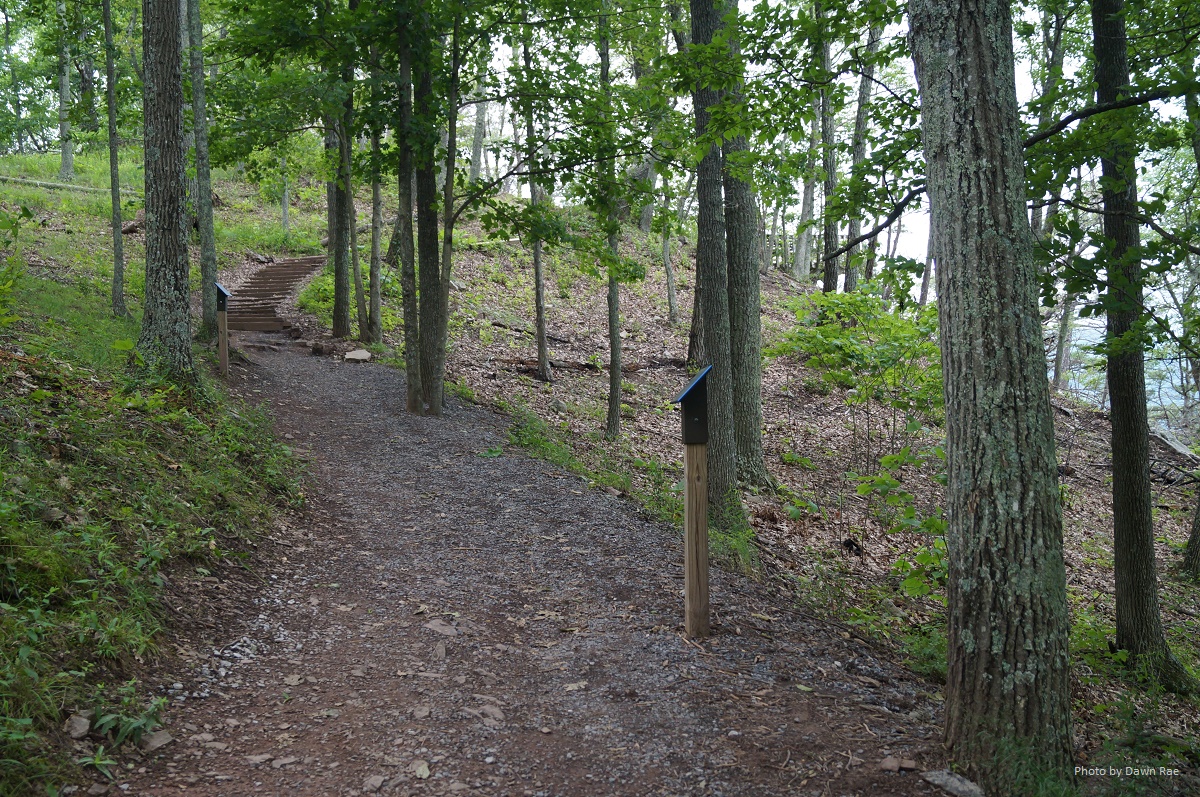
The trail heading up. At first it began almost flat. A deceiving portion of very easy trail. To experienced hikers, the entire trail would be considered easy as it is a wide and well-maintained trail. But it was challenging to me.


When I arrived at these stairs, I nearly gave up. I was hot and the trees had stifled any breeze. I pushed myself and made it to the top of the MANY stairs. And I sat on that rock for a good bit of time to rest. 


This is the top of the trail. There is a large sign just beyond this point that warns of the dangers to hikers who continue past this point. Deaths have occurred by the casual hikers not heeding the warnings. As tempting as it was to start climbing the rocks, I opted to remain on solid ground. I did not want to become famous for being the Gramma that fell off Seneca Rocks.

Yes, it rained as soon as I got to the top. But the rain was cooling and brief.


The walk down was faster than the climb up. But by then I was so relieved to arrive at the river... which meant I was only a few more steps away from the bathroom and then the cushioned seat of my Jeep. 


As I exited the area, I took one more look back. What a wonderful adventure this was. 


*This article may contain affiliate links. If you shop via one of the affiliate links, I may earn a small commission - at no additional cost to you. I am very appreciative of every reader who visits my articles. Thank you.

Sunday, June 3, 2018

Tales: Flat Broke with Two Goats

Tales: Flat Broke with Two Goats
I finished reading Flat Broke with Two Goats several weeks ago. I wanted to review the book immediately as it brought up strong feelings but I wasn't sure how to put my thoughts into words. I think I'm ready now. 

Despite mixed feelings about this memoir, both good and bad, the book kept me engrossed. In fact, I'll likely read it again.

I borrowed Flat Broke with Two Goats from the library and was very excited to find it. I hadn't seen it advertised previously and at first glance I thought it was a memoir about transitioning to a homestead while flat broke - a similar story to mine. However, it turns out that it was not quite a story like mine. In fact, parts of her story are very different than mine.

Flat Broke with Two Goats is a memoir written by Jennifer McGaha. It is not a "how-to" transition to a homestead when you want to. It is a life story about not planning, taking money for granted, and ending up in a run down cabin. And I came to think of it as a "how-not-to".


McGaha and her husband were living the American dream; buying a house in suburbia, raising kids, and apparently over-spending. A kid in college and kids in private schools. She's very honest that during her childhood, money was available and she can to think of money as always there. The Great Recession hits in the same time range they caught owing years of back taxes. Her accountant husband had less work due to the economy and while he wasn't really keeping them afloat financially to begin with (e.g. not able to pay taxes) they really began to flounder with the electricity being shut off and cars being repossessed. Finally, the home was in foreclosure. 

Throughout the book, McGaha is unhappy. Unhappy that her husband didn't tell her about the back taxes, unhappy that they ended up moving to a rickety old cabin infested with snakes, and unhappy that so many things happened to her. At one point, she moves out to take an adjunct teaching job. Then she moves back to the rickety cabin, her dogs, and her husband. 

And they begin to buy chickens and goats.

At first I was irritated that the story wasn't more about chickens, goats, and homesteading. I felt the advertising that it was about the traditions of Appalachia was false advertising. I was irritated that they got goats when they didn't seem prepared for goats. I was worried about the dogs. I was annoyed that the author was committing to lives that she couldn't afford to commit to. 

But the story grew on me. And McGaha has an interesting writing style. 

While I've never, ever been able to take money for granted, I have tried to run from problems I've helped create. There have been times I haven't faced my responsibilities. And there have been MANY occasions that the grass looked greener on the other side. I have jumped in to situations I wasn't prepared for.  I have lived in denial. Haven't we all? That's life. And in that way, she writes an unflinching story about life and what it is to be human.

Flat Broke with Two Goats is an interesting how-not-to. How-not-to take a six figure household income for granted. How-not-to keep spending when times get tough and bury your head in the sand when the repo man becomes a familiar person. 

It is also a story of a mom who wanted the good life for her human kids and who was wondrous at the birth of the goat kids. McGaha learns to make soap and cheese, and shares relevant recipes at the end of the chapters. In her quiet moments, she thinks of her connection with relatives long ago who worked hard in Appalachia. 

You may like her or you may hate her, but McGaha knows how to write and how to tell an entertaining story.

*This article may contain affiliate links. If you shop via one of the affiliate links, I may earn a small commission - at no additional cost to you. I am very appreciative of every reader who visits my articles. Thank you.